


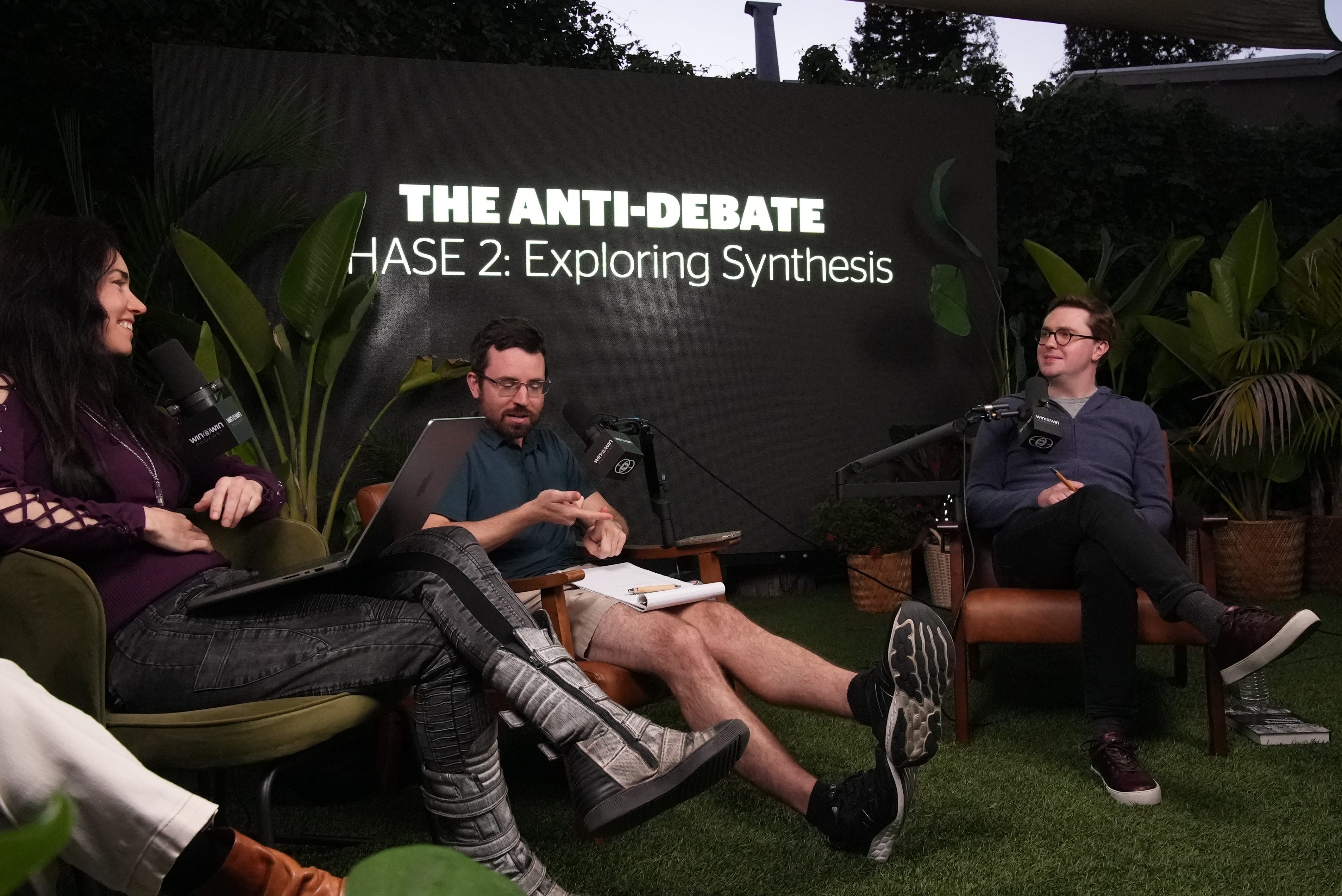
Advanced AI is coming. Should the government step in to guide its development, or should we leave it up to the market? Or is there a more nuanced way to think about this topic?
Enter The Anti-Debate — a new format for debate where participants build on each other’s insights, so that greater complexity can emerge. The format starts out like a traditional debate, with opening statements and rebuttals, but then it goes further — guiding participants to explore how they might integrate their perspectives into a bigger picture. The Anti-Debate is the latest production of Synthesis Media.
A few weeks ago, Synthesis Media hosted our first *live* Anti-Debate! Game theory expert Liv Boeree moderated an Anti-Debate on AI governance between former Trump AI advisor Dean W. Ball and OpenAI researcher-turned-whistleblower Daniel Kokotajlo:
These were some key points of synthesis between Daniel and Dean:
Shared concern about concentrated power — but different failure modes. Both converged on the idea that concentration of power is dangerous, whether in governments or corporations. The real question isn’t “state vs. market,” but how to prevent any actor (especially the executive branch or a dominant lab) from becoming unaccountable.
Alignment is the central problem — and neither side fully trusts current actors to solve it. Despite different policy instincts, both agreed that AI alignment and safety are unresolved and urgent, and that neither markets nor governments can be blindly trusted to handle it well without better verification, auditing, and incentives.
The real crux is a tradeoff: AI catastrophe risk vs. government overreach. The deepest synthesis emerged around a shared framing: at what point do risks from AI outweigh risks from centralized power? Both acknowledged their views would shift based on evidence — making this less about ideology and more about updating under uncertainty.
My favorite moment of the entire Anti-Debate was when Dean steel-manned Daniel, and Daniel visibly softened. Dean said, “I keep waiting for you to be wrong...but you’ve basically been right about timelines so far.” And Daniel responded, “I feel appreciated...and understood.” There was a powerful vibe shift. At that moment, the Anti-Debate evolved from adversarial to collaborative.
If you’d like to go deeper, check out this excellent write-up of the Anti-Debate by Thomas Brady. His key insight was that the AI governance debate assumes the relevant contest is government vs. industry. But the actual power topology is two private industry coalitions — frontier AI labs vs. defense tech like Palantir and Anduril — using state power against each other, with government serving as a tool rather than a counterweight. The question therefore isn’t ‘to what extent government regulation?’ but ‘whose values get encoded into AI systems as the republic itself decays?’ — which essentially brings us back to alignment.
More Anti-Debates are forthcoming! Liv and I are planning to do one around the release of The AI Doc, featuring people from the film. To stay tuned, subscribe here and on the Anti-Debate website.