


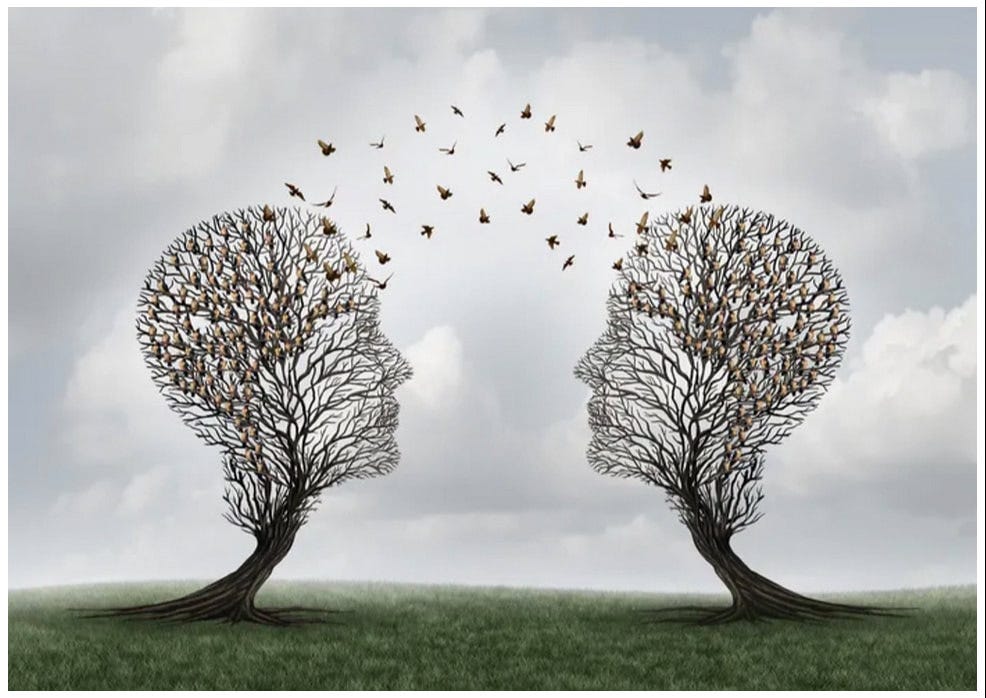
We live in a cacophony. Our dominant media business model — based on maximizing engagement — is polluting our information commons, resulting in shorter attention spans, binary thinking, and hyper-polarization.
In theory, public debates should strengthen democracy, by exposing citizens to diverse perspectives and reasoned arguments. But in practice, debates are further polarizing us, as debaters straw-man each other to score points for their tribe. Recent U.S. presidential debates may not even qualify as actual debates, since participants are engaged less in a structured back-and-forth about opposing views, and more in an unstructured barrage of attack lines. Quoting The Consilience Project, “when open communication cannot be used to resolve conflict and coordinate behavior, societies are driven towards chaos, war, oppression, and authoritarianism.”
Meanwhile, humanity has a rich legacy of dialogic practices. Throughout history, wisdom traditions worldwide have developed unique forms of cooperative argumentation, such as Jesuit disputation, Tibetan Buddhist debate, and Talmudic havrutah.
In havrutah, for example, Jews study the Talmud in pairs because it’s by virtue of having different perspectives that students sharpen each other’s intellect. In Socratic dialogue, probing questions are used to stimulate critical thinking, and have become a foundational element of Western philosophical and educational traditions. In more modern times, the Oxford-style debate emerged to enable rigorous yet productive argumentation, and has been adopted in academic and public debate settings worldwide.

It’s time to draw from our legacy of dialogic wisdom, and innovate a debate format that can meet the moment.
Introducing The Anti-Debate — a new and open-source format for debate where participants build on each other’s insights, so that greater complexity can emerge.

The Anti-Debate derives its name from William MacAskill, philosopher and co-founder of Effective Altruism. In 2017, he proposed “anti-debates” as an alternative to a traditional debate – which would focus on seeking truth instead of defending sides. The idea was then popularized by philosophers Peter Limberger and Connor Barnes – who imagined how anti-debates could transform the 2020 U.S. presidential election. Since 2022, think tank Perspectiva has been experimenting with its own form of antidebate. The Anti-Debate you see here — and on the project website — is Synthesis Media’s manifestation of a big idea.
In order to create this Anti-Debate, I researched a variety of dialogue and debate practices – from Socratic dialogue to Oxford Debate to Bohmian Dialogue. I cobbled together a draft format, conducted trial runs, and came out with a v1 Anti-Debate that Synthesis Media is now launching to the world.
To be clear, the Anti-Debate is not anti-debate! It actually starts out like a traditional debate with opening statements and rebuttals, but then, it doesn’t stop there. It goes further! Thank you for clarifying your different perspectives. Now that you’ve put your ingredients on the table, it’s time to make something new 😉
You’re invited to use and remix the Anti-Debate! Naturally, it’s useful for people who facilitate debates, like podcast hosts and educators. But if you seek to engage different perspectives in a productive way — whether around the family dinner table, or in the boardroom, or in the bedroom — the Anti-Debate is for you.
Zooming back out: imagine if we used our different perspectives on our most important issues not to further divide us, but to see those issues with greater complexity. Ultimately, the goal of the Anti-Debate is not to change minds, but to expand minds. We’re not looking to convert you to me, or me to you, but to give all of us a more comprehensive view. We’re on the same team to sharpen each other’s intellect. Hence the tagline of the Anti-Debate: a debate that everyone can win.
And like anything, the Anti-Debate can be weaponized. Again quoting The Consilience Project, “individuals must therefore continually innovate in their approach to communication. We must work together always to find new ways to break the hegemony of bad faith. This should be done as if the future of civilization depends on it—because it does” (emphasis added).
To learn more about the Anti-Debate, check out the How-To Guide, and adapt it for your purposes — visit: anti-debate.org
The aspiration to expand minds rather than change them is compelling and I especially appreciate the acknowledgement that even this format can be weaponized. That realism strengthens the whole idea.
Nice ! Should be in schools and colleges!. Can there be workshops for us older folks as well for some practical experience?